An AI LinkedIn workflow that starts with source material and perspective
KnownVoice helps you move from source material and point of view to research and draft, then add personal takes during review before approval. The strongest drafts start from topics you understand, not topics AI invented for you.
See what goes in before you see what comes out
The useful part of AI-supported LinkedIn content is not the button press. It is the thinking the system has to work with before a draft exists.
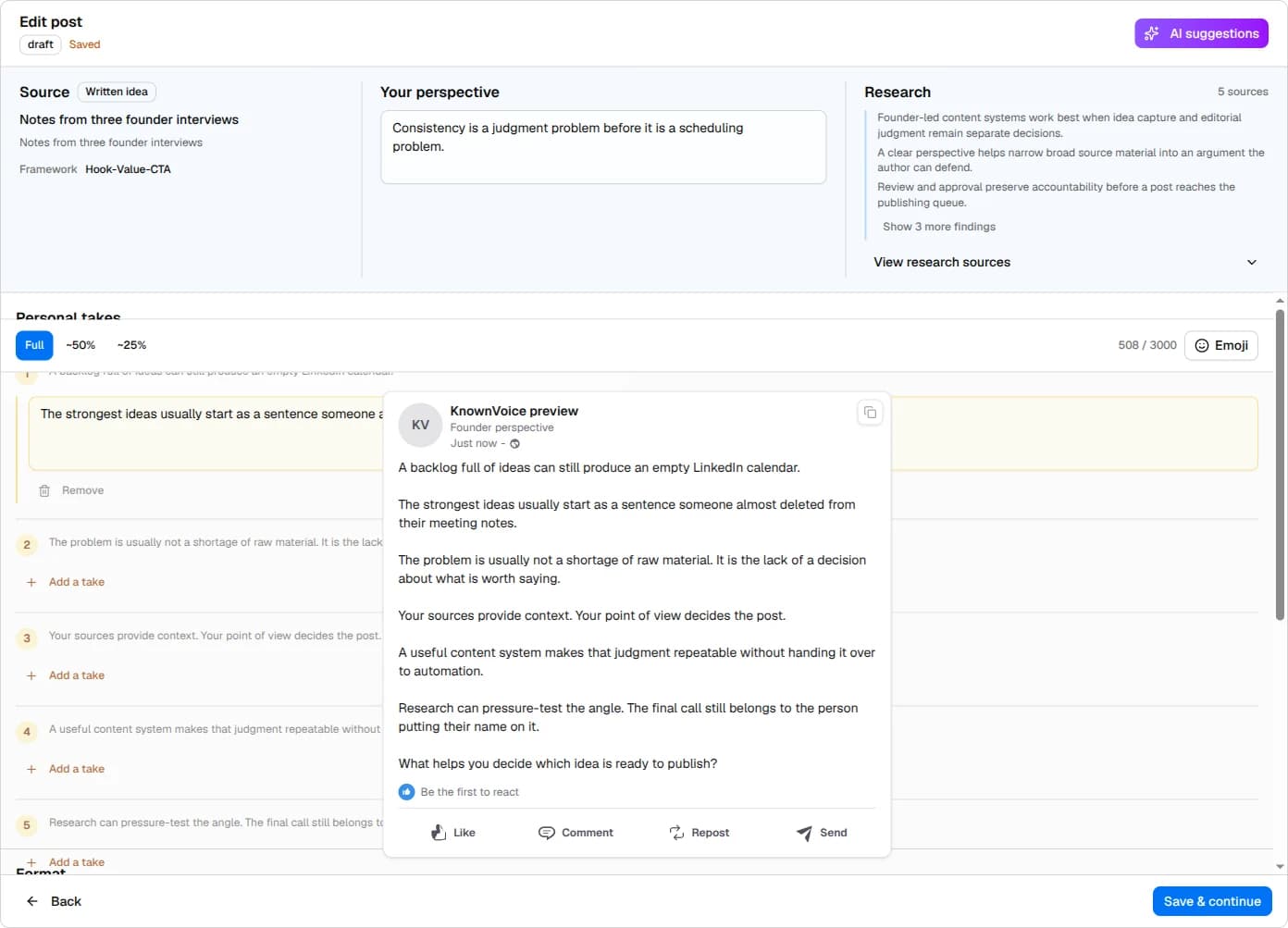
A voice note after a customer call: teams keep asking for AI content, but they really need a sharper point of view before the draft starts.
The angle is not AI saves time. The angle is that source material and judgment should lead, and AI should support the work.
Clarify the topic against your perspective, pressure-test the tension, and avoid invented examples or unsupported performance claims.
Once the draft exists, add specific commentary where it strengthens the post and makes the draft sound more like you.
A LinkedIn post you can review, edit, approve, schedule, or publish when it is ready.
Start with the thinking you already have
Strong LinkedIn posts usually start outside a writing tool. KnownVoice gives that raw material a path into a draft you can judge.
Feeds and URLs
Bring RSS feeds, articles, product pages, and market links when you can connect them to what you know, saw, built, or believe.
Text ideas and drafts
Turn rough notes, half-written posts, and copied observations into material the workflow can shape.
Voice notes and videos
Use spoken ideas, interviews, demos, or video context when the useful thinking is not already written down.
Perspective first, takes later
Set the overall angle you actually believe before research. Once the draft exists, add specific commentary where it strengthens the post.
A LinkedIn workflow built for judgment, not volume
KnownVoice is built for people who want AI to support the work: source material, trusted point of view, research, draft, personal takes, and approval.
Bring the source-backed topic
Start from something you understand: a customer call, product decision, market observation, URL, draft, voice note, or note from the week.
Set the perspective
Your overall angle on the topic. This gets researched together with the source material so the direction is informed by what you know and what you believe.
Research before drafting
The research step gives the AI topic context against your perspective before it writes the LinkedIn post.
Add personal takes to the draft
Once the draft exists, add specific commentary from your experience so the final post sounds more like you.
Approve before publishing
You get a post to review, edit, approve, schedule, or publish when the words are ready.
What we avoid
- Empty-prompt output dressed up as strategy.
- Engagement automation, auto-likes, auto-comments, or pods.
- Mass outreach, connection farming, or bulk messaging.
- Publishing triggered without an explicit action from the person using the account.
What we protect
- Source material and context before the draft exists.
- Your perspective shapes the research direction.
- An explicit user action to schedule or publish.
- Authorized LinkedIn publishing through supported APIs.
KnownVoice compared with quick generators
Free generators
Good for a quick draft from a topic and tone. Weak when the post needs your judgment, perspective, or source context.
Generic AI chats
Flexible, but you still have to prompt, fact-check, rewrite, and manage publishing somewhere else.
KnownVoice
Built for source, perspective, research, draft, personal takes, approval, scheduling, and publishing.
Founder-led company?
See how KnownVoice turns topics you understand, supporting sources, voice notes, and perspective into researched LinkedIn posts.
Questions before using AI for LinkedIn
The boundaries matter as much as the draft.
Will it preserve my voice and point of view?
That is the goal. KnownVoice starts from your source material, perspective, brand guidelines, voice profiles, and founder-led variants, then lets you add personal takes during review so drafts stay closer to how you actually think and write.
Does KnownVoice research before writing?
Yes. KnownVoice researches before drafting so the post can be grounded in context instead of starting from a blank prompt.
Can I approve posts before they publish?
Yes. You can review, edit, and approve a post before publishing. Scheduling or immediate publishing always requires an explicit user action.
How is this different from a free AI post generator?
Free generators usually create a quick draft from a topic and tone. KnownVoice is a fuller workflow for source-backed topics, point of view, research, draft review, personal takes, approval, scheduling, and publishing.
How does publishing to LinkedIn work?
KnownVoice publishes through the official LinkedIn API path available to the product. It does not use browser automation to publish or simulate engagement.
Does this promise LinkedIn engagement or business results?
No. KnownVoice helps you create, approve, schedule, and publish LinkedIn content, but it does not promise impressions, engagement, followers, or business results.
Turn real inputs into LinkedIn posts you can approve
Start with the ideas, links, voice notes, videos, and topics where you have a perspective. KnownVoice helps turn them into LinkedIn content with source material, research, draft review, personal takes, and approval in the loop.